On localization of software

This story took place a few years ago. Some things have changed since then, some details may not hold today. But I still think of it from time to time, and I guess now I'll make you think about it too (at least for the next few minutes).
I'm a big fan of the Markdown format. I've been using it to write my own private notes and public blog posts since forever. I used it for many a readme and technical documentation at work. You can imagine my excitement when I found out about Obsidian. Soon I started couple of vaults (projects) and found the perfect use-case for it in organizing my notes on a D&D campaign that I was playing in.
Being a stereotypical tech bro husband I kept nagging my wife, also a player in that campaign, to give it a try. From D&D to recipes, I kept pointing out opportunities to take notes in Obsidian. The kicker is that she actually enjoys organizing information, and is really good at it. Far better than me. So I was genuinely excited to share a cool tool I found with her.
Eventually she gave in and installed the program. I was giddy, sitting next to her, babbling on about interlinked pages and stuff. I told her how simple the Markdown formatting is; # for headings, _ for italics and ** for bold. Back then Obsidian lacked a rich text editor; you had to edit notes in the Markdown syntax. And then came the time to add the first link between 2 notes: an aha moment if there ever was one. I smugly told her to put the note name between double square brackets.
This is where locale comes into the story. In Croatia, we use Latin alphabet with five extra letters added in: š, đ, ž, č and ć. As a result, we use a distinct keyboard layout: South Slavic Latin QWERTZ (yeah, that's a Z at the end there, Z and Y are swapped for some reason 🙃):

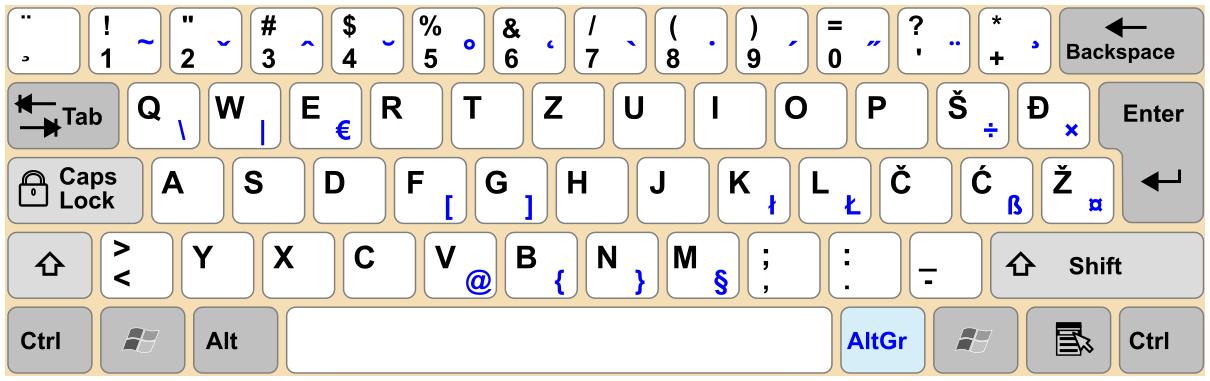
You may notice that [ and ] characters are drawn in blue inside F and G keys. They can be accessed by holding down the AltGr together with F or G. And AltGr (alternative graphic?!) is usually the key right of the space bar. This is fine most of the time; Croatian typists can access the letters of our alphabet easily. We can access most special characters in the number row by holding down Shift . AltGr is seldom used, outside of perhaps @ or € characters. Unsurprisingly, manufacturers often decide to simplify our lives:

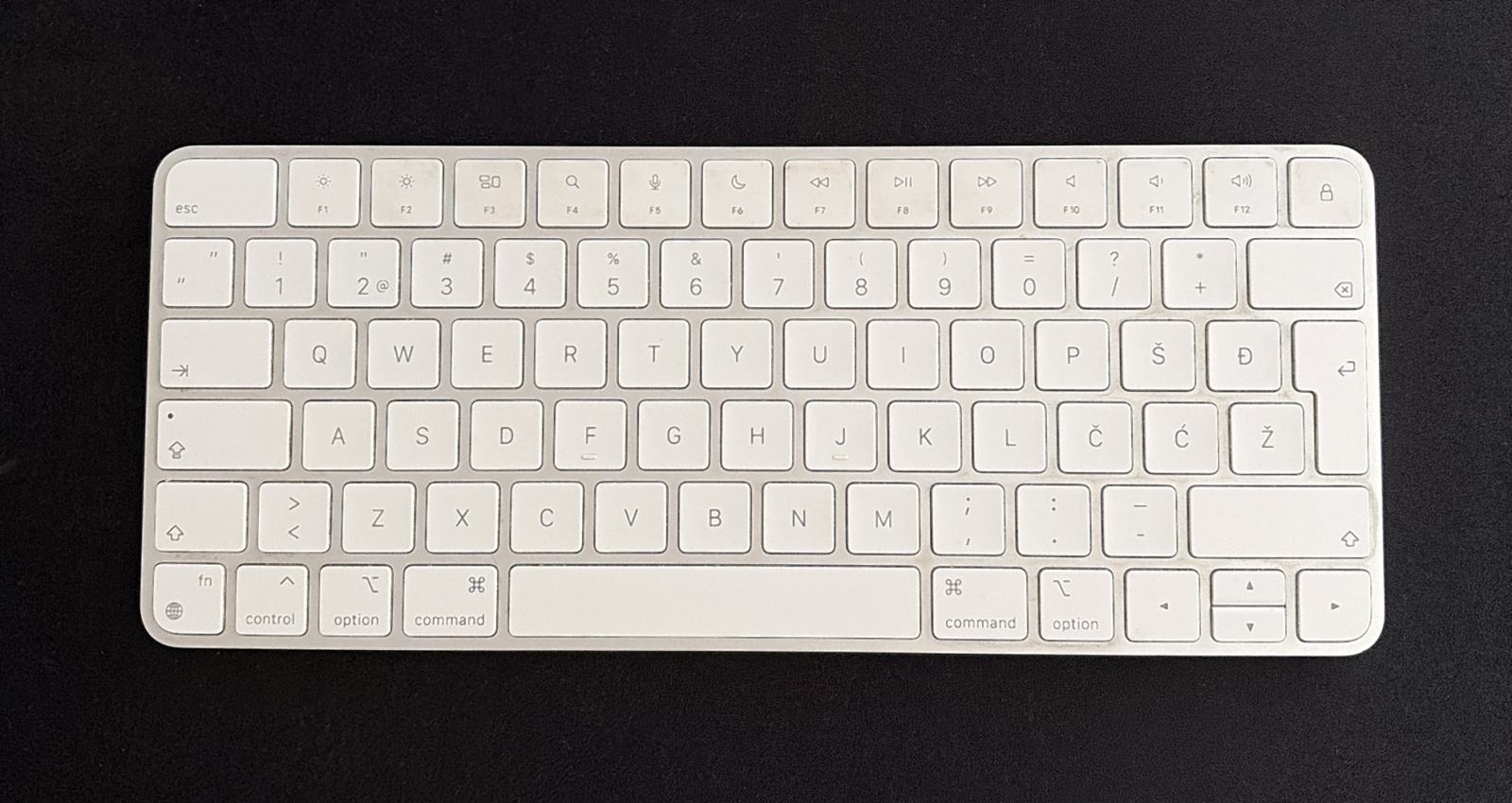
This is one of the recent Apple Magic keyboards. Note the total absence of those AltGr characters. @ is mingled with " on the 2. [ and ] are nowhere to be found.
My wife looked me like I had told her to type a Hieroglyph. Needless to say, her Obsidian journey ended there.
The conditions were almost perfect. Our alphabet is close to Latin, our keyboard layout is mostly the same as the US layout. My wife is English translator, the language itself is no barrier. And she's tech savvy, she'd have no problem working with Obsidian otherwise.
In this case I put the blame on my dear Markdown format. You could translate the Obsidian UI, but it wouldn't have helped. You could implement a rich text editor, and ok, yes, that does help a little. Btw, Obsidian has it nowadays, so perhaps it would have gone down differently today. But the fact remains: Markdown, the lightest of mark up formats, a far cry from programming or scripting languages' syntax, is still unwritable.
As a programmer I use keyboards with the US layout. Access to keys such as ; without modifiers is too useful. Unfortunately, that also means I can't spell my own surname with characters printed on the key-caps. And once again, I have a near-perfect conditions. Think of what that means for people around the world. What seems like the simplest, least obtrusive format might read as hieroglyphics to them.